
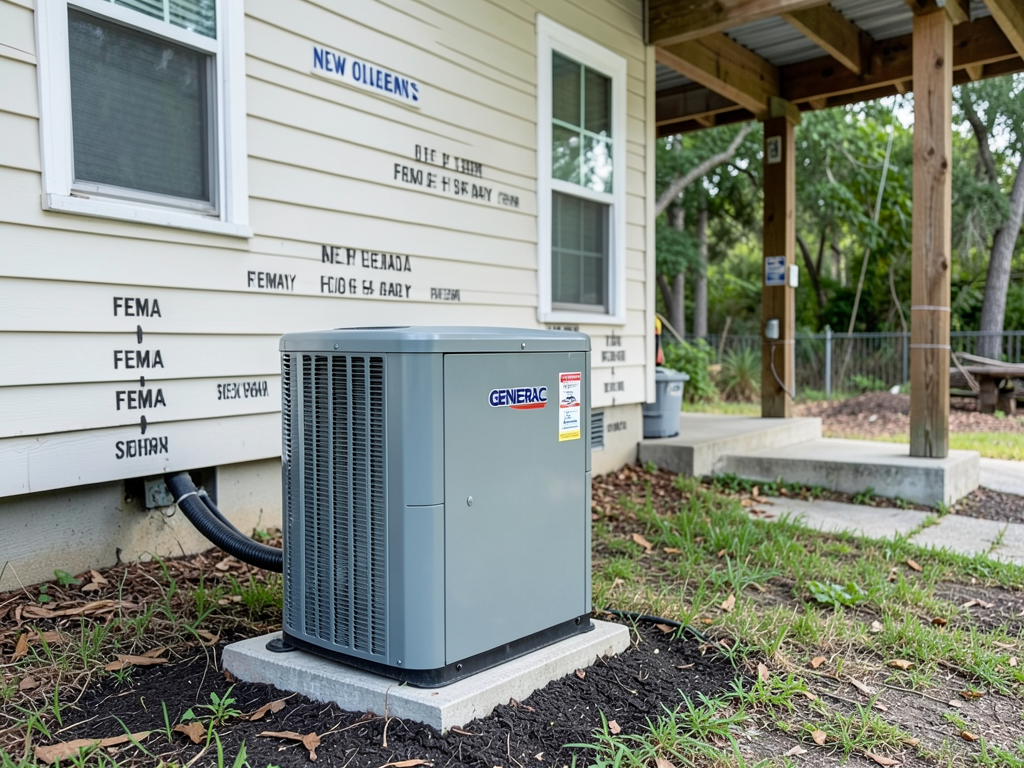
Can Your Whole Home Generator Actually Power Your AC During a Blackout?
Running your air conditioner during a New Orleans blackout is possible but most generators fail on the first startup because of the massive surge current. A typical 3-ton central AC needs 30-40 amps just to start the compressor even though it only runs at 10-15 amps once spinning. Without the right equipment your generator will trip or shut down before the compressor ever cools your home. Get Your New Orleans AC Running Again with Our 24-Hour Emergency Repair Service.
The good news is that with proper sizing a soft start kit and the correct transfer switch your generator can keep your home cool through even the longest Entergy outage. This guide breaks down the math the equipment and the local codes so you can make the right choice before hurricane season hits. Entergy New Orleans.
Calculating the Load: Sizing Your Generator for NOLA Heat
BTU ratings on your AC do not translate directly to generator wattage. A 3-ton (36,000 BTU) unit may only use 3,500 running watts but needs up to 10,000 watts at startup. Here is a quick reference for common residential AC sizes: Why Your Lakeview Home Needs a High-Efficiency AC Unit to Combat Swampy Humidity.
| AC Size (Tons) | BTU Rating | Running Watts | Starting Watts |
|---|---|---|---|
| 1.5 | 18,000 | 1,500-2,000 | 4,500-6,000 |
| 2.0 | 24,000 | 2,000-2,500 | 6,000-7,500 |
| 3.0 | 36,000 | 3,000-3,500 | 9,000-11,000 |
| 4.0 | 48,000 | 4,000-5,000 | 12,000-15,000 |
New Orleans homes in Lakeview and Metairie often have 2-3 ton units meaning you need at least an 8,000-watt portable or a 10,000-watt standby generator just for the AC. Add lights fridge and fans and that number climbs fast. Fighting New Orleans Humidity with a Professional Whole-Home Dehumidifier Installation.
Starting Amps vs. Running Amps (LRA Explained)
The biggest hurdle is Locked Rotor Amps or LRA. This is the inrush current when the compressor tries to start from a dead stop. LRA can be 5-7 times the Running Load Amps (RLA). If your generator cannot deliver that spike the compressor never starts and you are left in the heat.
Technicians measure LRA with a clamp meter during a cold start. A healthy compressor might show 60-70 amps LRA for a split second before settling to its normal 15-20 amp RLA. If LRA is higher than expected it can signal worn bearings low voltage or a failing capacitor all of which make generator startup even harder.
The ‘Soft Start’ Solution
A soft start kit like the Micro-Air EasyStart reduces the initial surge by up to 70 percent. Instead of dumping full voltage to the compressor it ramps up power gradually keeping the inrush below what a smaller generator can handle. This means a 5,000-watt inverter generator can now run a 2-ton central AC that would otherwise need 8,000 watts. Micro-Air EasyStart.
Installation takes about two hours and must be done by a licensed HVAC technician to keep the compressor warranty intact. The kit wires into the compressor terminals and communicates with the control board. Once installed you can run your AC on a fuel-efficient inverter generator instead of a large noisy portable unit.
Portable vs. Whole-Home Standby Generators
Portable generators are cheaper upfront but require manual setup extension cords and constant refueling. A 7,500-watt portable might run your AC and a few lights but you will burn 12-15 gallons of gas in 24 hours. Fuel storage and CO safety become major concerns during multi-day outages.
Whole-home standby units from Generac or Kohler automatically kick on within seconds of an outage. They run on natural gas or propane so no refueling is needed. A 14-20 kW standby can handle central AC lights fridge and even well pumps. The trade-off is a higher install cost and the need for a proper transfer switch.
Transfer switches are required by the National Electrical Code (NEC Article 702) to prevent backfeeding the grid which can electrocute utility workers. Manual transfer switches cost less but must be flipped by hand. Automatic transfer switches cost more but restore power without you lifting a finger.
Safety Warnings & New Orleans Codes
Carbon monoxide is the number one killer during generator use. Always run portable units at least 20 feet from doors and windows and never inside a garage or carport. Install battery-powered CO detectors on every level of your home.
New Orleans follows the 2020 Louisiana State Uniform Construction Code which adopts the International Residential Code with local amendments. Outdoor condenser placement must meet FEMA elevation requirements in flood zones and all electrical connections must be inspected by the city. Skipping permits can void insurance and leave you liable if a fire or shock occurs. Louisiana State Uniform Construction Code.
Entergy New Orleans requires a lockable disconnect if your generator ties into the main panel. This ensures linemen can isolate your home during repairs. A licensed electrician will pull the permit install the transfer switch and coordinate the final inspection.
Fuel Consumption Math for Hurricane Season
If you choose a portable unit plan your fuel supply now. A 5,000-watt generator running a 2-ton AC will consume about 0.6-0.8 gallons per hour. Over a 48-hour outage that is 30-40 gallons. Store fuel in approved containers add stabilizer and rotate stock every six months.
Propane standby units use about 2-3 gallons per hour at full load. A 500-gallon tank can run a 15 kW generator for 5-7 days nonstop. Natural gas flow depends on your meter size; most residential meters can handle 20-25 kW without an upgrade.
Maintenance to Minimize Generator Load
A dirty condenser coil or weak capacitor forces the compressor to work harder increasing both running and starting amps. Before storm season clean the outdoor coil check refrigerant charge and test capacitors with a multimeter. Replace any part that is out of spec to keep the load as low as possible.
Also check your ductwork for leaks. In a raised pier-and-beam home common to New Orleans torn flex ducts under the house can waste 20-30 percent of your cooling before it ever reaches the vents. Sealing those leaks reduces the runtime your generator needs to keep you comfortable. Emergency Ductwork Repair.
Choosing the Right Generator for Your Home
Start with your AC size and add up essential loads: fridge lights fans medical devices. Use the table above to estimate starting watts then add 20 percent for safety. If the total is under 5,000 watts a quality inverter generator with a soft start kit may be enough. If it is over 7,000 watts consider a standby unit.
Noise is another factor. Portable generators can exceed 70 dB at 20 feet while standby units are usually under 60 dB. In a dense neighborhood like Lakeview or Algiers that difference matters to your neighbors and your own sanity during a long outage.
Finally think about logistics. A portable generator needs to be wheeled out fueled and connected each time the power fails. A standby unit is wired in once and forgotten until it saves the day. For most New Orleans homeowners the convenience and safety of a standby system pays for itself the first multi-day outage.
Frequently Asked Questions
Can I run my AC on a 5,000-watt generator?
Only if you install a soft start kit. Without it the startup surge will trip most 5,000-watt units.
How long will a standby generator run during a hurricane?
Propane or natural gas units can run indefinitely as long as fuel is supplied. A 500-gallon propane tank can last 5-7 days at typical household loads.
Do I need a permit to install a generator in New Orleans?
Yes. Electrical connections require a city permit and inspection under the Louisiana State Uniform Construction Code.
Will a portable generator damage my AC electronics?
Cheap generators can produce dirty power with high total harmonic distortion. Use an inverter generator or a standby unit with clean power output to protect control boards.
What size generator do I need for a 4-ton AC?
Plan for at least 15,000 starting watts and 5,000 running watts. A 20 kW standby is a safer choice to handle the surge and other household loads.
Ready to Keep Your Home Cool When the Power Goes Out?
Call (504) 355-2955 today to schedule your inspection. Our licensed technicians will calculate your exact load recommend the right generator and handle all permits and code compliance. Do not wait until the next storm is on the way get peace of mind now.
Pick up the phone and call (504) 355-2955 before the next storm hits. Your comfort and safety are too important to leave to chance.
{
“@context”: “https://schema.org”,
“@type”: “BlogPosting”,
“headline”: “Can Your Whole Home Generator Actually Power Your AC During a Blackout?”,
“description”: “Find out if your generator can handle your AC during a New Orleans blackout. Learn about sizing, soft starts, and local codes to keep your home cool.”,
“wordCount”: 1429,
“datePublished”: “2026-04-06T08:24:00.000Z”,
“dateModified”: “2026-04-06T08:24:00.000Z”,
“inLanguage”: “en-US”,
“mainEntityOfPage”: {
“@type”: “WebPage”,
“@id”: “https://pioneerhvacneworleans.com”
},
“publisher”: {
“@type”: “LocalBusiness”,
“name”: “Pioneer HVAC New Orleans”,
“url”: “https://pioneerhvacneworleans.com”
},
“author”: {
“@type”: “Organization”,
“name”: “Pioneer HVAC New Orleans”,
“url”: “https://pioneerhvacneworleans.com”
},
“image”: {
“@type”: “ImageObject”,
“url”: “https://pioneerhvacneworleans.com/wp-content/uploads/2026/03/can-your-whole-home-generator-actually-power-your-1.png”
}
}
{
“@context”: “https://schema.org”,
“@type”: “HVACBusiness”,
“name”: “Pioneer HVAC New Orleans”,
“url”: “https://pioneerhvacneworleans.com”,
“address”: {
“@type”: “PostalAddress”,
“addressLocality”: “New Orleans”
},
“areaServed”: {
“@type”: “City”,
“name”: “New Orleans”
}
}
{
“@context”: “https://schema.org”,
“@type”: “FAQPage”,
“mainEntity”: [
{
“@type”: “Question”,
“name”: “Can I run my AC on a 5,000-watt generator?”,
“acceptedAnswer”: {
“@type”: “Answer”,
“text”: “Only if you install a soft start kit. Without it the startup surge will trip most 5,000-watt units.”
}
},
{
“@type”: “Question”,
“name”: “How long will a standby generator run during a hurricane?”,
“acceptedAnswer”: {
“@type”: “Answer”,
“text”: “Propane or natural gas units can run indefinitely as long as fuel is supplied. A 500-gallon propane tank can last 5-7 days at typical household loads.”
}
},
{
“@type”: “Question”,
“name”: “Do I need a permit to install a generator in New Orleans?”,
“acceptedAnswer”: {
“@type”: “Answer”,
“text”: “Yes. Electrical connections require a city permit and inspection under the Louisiana State Uniform Construction Code.”
}
},
{
“@type”: “Question”,
“name”: “Will a portable generator damage my AC electronics?”,
“acceptedAnswer”: {
“@type”: “Answer”,
“text”: “Cheap generators can produce dirty power with high total harmonic distortion. Use an inverter generator or a standby unit with clean power output to protect control boards.”
}
},
{
“@type”: “Question”,
“name”: “What size generator do I need for a 4-ton AC?”,
“acceptedAnswer”: {
“@type”: “Answer”,
“text”: “Plan for at least 15,000 starting watts and 5,000 running watts. A 20 kW standby is a safer choice to handle the surge and other household loads.”
}
},
{
“@type”: “Question”,
“name”: “Ready to Keep Your Home Cool When the Power Goes Out?”,
“acceptedAnswer”: {
“@type”: “Answer”,
“text”: “Call (504) 355-2955 today to schedule your inspection. Our licensed technicians will calculate your exact load recommend the right generator and handle all permits and code compliance. Do not wait until the next storm is on the way get peace of mind now.”
}
}
]
}
{
“@context”: “https://schema.org”,
“@type”: “BreadcrumbList”,
“itemListElement”: [
{
“@type”: “ListItem”,
“position”: 1,
“name”: “Home”,
“item”: “https://pioneerhvacneworleans.com”
},
{
“@type”: “ListItem”,
“position”: 2,
“name”: “Blog”,
“item”: “https://pioneerhvacneworleans.com/blog”
},
{
“@type”: “ListItem”,
“position”: 3,
“name”: “Can Your Whole Home Generator Actually Power Your AC During a Blackout?”
}
]
}
{
“@context”: “https://schema.org”,
“@type”: “Service”,
“serviceType”: “HVAC”,
“provider”: {
“@type”: “LocalBusiness”,
“name”: “Pioneer HVAC New Orleans”,
“url”: “https://pioneerhvacneworleans.com”
},
“areaServed”: {
“@type”: “City”,
“name”: “New Orleans”
},
“description”: “Find out if your generator can handle your AC during a New Orleans blackout. Learn about sizing, soft starts, and local codes to keep your home cool.”
}